


| |
|
|
| |
Lasik |
|
| |
|
|
| |
LASIK (or laser assisted in situ keratomilieusis) is
currently the most popular method in the world for the correction
of refractive errors (spectacle powers). Shroff Eye Centre and its
dedicated team of refractive surgeons offers you laser vision correction
to reduce your dependence on glasses or contact lenses. |
|
| |
|
|
| |
Why Laser Vision Correction at Shroff Eye Centre? |
|
| |
Eligibility criteria are strictly adhered to.
Each patient undergoes a pre-operative examination for factors such as corneal
thickness (pachymetry), corneal shape (topography), retinal examination
for retinal status.
The FDA approved VISX STAR S4 Excimer Laser
used has the maximum built in safety features, including the unique
3 D active tracking system which tracks your eye for the minutest
of movement during surgery. This helps in precise delivery of laser
at the right place with less tissue removed resulting in fast treatment
and faster recovery.
Strict adherence to sterilization and asepsis.
Post-operative follow up is done by qualified cornea and refractive
surgeons.
|
|
| |
|
|
| |
Learn about refractive errors and
laser vision correction. |
|
| |
What are the causes of
focusing problems? |
|
| |
Nearsightedness, or
myopia |
|
| |
Farsightedness, or hyperopia |
|
| |
Astigmatism |
|
| |
What are the life-style
benefits of laser vision correction? |
|
| |
Do you qualify for Laser
Vision Correction? |
|
| |
How does laser vision
correction work? |
|
| |
What is LASIK? |
|
| |
What is Customized LASIK
(Advanced CustomVue Treatment)? |
|
| |
The STAR S4 IR Excimer
Laser Machine at Shroff Eye Centre |
|
| |
The LASIK Procedure
|
|
| |
What happens after
LASIK? |
|
| |
Risks and side effects
of LASIK |
|
| |
Epi-LASIK Eye Surgery
|
|
| |
QUESTIONS & ANSWERS
|
|
| |
|
|
| |
What are the causes
of focusing problems? |
|
| |
Focusing problems of the eye, which require correction by glasses
or contact lenses, are called refractive errors. These are:
Myopia, also called shortsightedness or nearsightedness
Hypermetropia (Hyperopia) also called or longsightedness or farsightedness
Astigmatism - those using cylindrical correction in their glasses
|
|
| |
|
|
| |
Nearsightedness,
or myopia |
|
| |
It
is the most common focusing problem, affecting a significant proportion
of the Indian population. Nearsighted people can see various ranges
of near objects clearly but not distant objects. Nearsightedness
usually results from an eyeball that is too long. Because of this
extra length, light from distant objects converges to a focal point
before it reaches the retina at the back of the eye. Beyond the
focal point, the light then begins to diverge. Since the retina
only captures the quality of the image that reaches it, the brain
receives a blurred image of what the eye is trying to see.
Nearsighted people need to wear minus-powered spectacles or contact
lenses to see clearly.
|
|
| |
Go back
to the top » |
|
| |
Farsightedness, or
hyperopia |
|
| |
This
is a focusing problem caused by an eyeball that is shorter than normal.
Due to the reduced length, the lens fails to bring light rays to a
focal point by the time they reach the retina. The effects of farsightedness
vary with age because of the diminishing flexibility of the lens.
Young people may not notice any effects. But as the eyes begin to
age, near objects become increasingly difficult to see. Later in life
nearly all focal ranges may be unclear. Farsighted people need to
use plus powered spectacles to see clearly. |
|
| |
|
|
| |
Astigmatism |
|
| |
Astigmatism
is the result of the general inability of the eye to clearly focus
images from any distance. It results from uneven curvatures of the
cornea. Instead of being spherical, it is more similar to the side
of an egg. This focusing problem usually occurs in combination with
nearsightedness, or farsightedness. People with astigmatism need to
use cylindrical correction in their glasses.
|
|
| |
|
|
| |
What are the life-style
benefits of laser vision correction? |
|
| |
LASIK
eye surgery offers multiple benefits to most people with refractive
errors:
Clear vision without the hassles and inconvenience
of corrective lenses - no more fears about being incapacitated in
an emergency if lenses are lost or glasses are broken. Expanded
career opportunities (police officers, firefighters, pilots, air
hostesses and professional athletes). Better vision for recreational
sports, especially water, winter and contact sports. Wider scope
of peripheral vision than what glasses provide. May be safer for
eye health than wearing contact lenses for an extended period of
time. New visual freedom for all aspects of life.
|
|
| |
Go back
to the top » |
|
| |
Do you qualify for
Laser Vision Correction? |
|
| |
To qualify for laser vision correction, you should:
Be at least 18 years of age. Have had stable vision for the past
one year (slight prescription changes may not disqualify you.) Have
corneas of adequate thickness as measured by Corneal Pachymetry and
normal shape (determined by Corneal Topography). Be free from complicating
eye diseases (assessed individually). Be free from systemic illnesses,
Collagen vascular disorders such as Rheumatoid Arthritis, Sjögrens
Syndrome, Systemic Lupus Erythematosus, etc. Not be pregnant or
nursing. Be off contact lenses for 1-3 weeks prior to the surgery
(this varies with the type of contact lens - soft or semi-soft). |
|
| |
|
|
| |
How does laser vision
correction work? |
|
| |
Laser vision correction works by using a high precision laser beam
to reshape the front surface of the cornea and allow light rays
to focus precisely on the retina. This high precision laser known
as Excimer Laser involves the use of 193 nm UV light, which is a
unique type of "cold" laser that does not burn or cut tissue. Instead,
it gently breaks the molecular bonds between the cells so that controlled
amounts of tissue can be literally vaporized away, one microscopic
layer at a time. Central tissue is removed to reduce the corneal
curvature and correct nearsightedness. Peripheral tissue is removed
to increase the corneal curvature and correct farsightedness. Astigmatism
can be corrected by removing selected tissue to even out the curvature
of the cornea.
|
|
| |
Go back
to the top » |
|
| |
What is LASIK? |
|
| |
For people wishing to have less dependence on glasses or contact
lenses, an excimer laser procedure called Laser Assisted in situ
Keratomileusis (LASIK) is currently the best way to achieve clear,
natural vision. This procedure had its origins back in the 1960s,
and has evolved over the years into a safe and effective operation.
This procedure was FDA recognized in September 1998.
In performing LASIK, the surgeon first uses a special oscillating
blade to make a partial cut through one fourth to one third of the
front surface of the cornea, creating a flap of clear tissue on
the central part of the eye.
The patient is then positioned under the excimer laser, which is
programmed to vaporize some of the internal corneal tissue under
the flap. After the laser has removed the selected tissue, the flap
is closed over the eye. The cornea has extraordinary natural bonding
qualities that allow effective healing without the use of stitches.
In the latest technique of i-LASIK or Blade-free LASIK, this flap
is created not by an oscillating blade, but by an advanced technology
called the Intralase Method utilizing a special laser (femtosecond
laser).
|
|
| |
|
|
| |
What is Customized
LASIK (Advanced CustomVue Treatment)? |
|
| |
Customized LASIK is an advanced form of laser vision correction,
which further enhances the precision of excimer laser surgery. This
is based on the fact that the human eye suffers not only from sphero-cylindrical
errors, which can be corrected with glasses or contacted lenses,
but also from numerous, minute optical imperfections or aberrations,
other than sphero-cylindrical refractive errors, which are not correctable
with glasses or contact lenses.
In customized LASIK, a unique technology called WaveScan captures
the unique imperfections in your vision that could not have been
measured and corrected before. WaveScan technology produces a detailed
map of your eye - much like a fingerprint, where no two are alike.
This new level of measurement provides 25 times more precision than
standard measurements used for glasses and contact lenses, and gives
your doctor treatment options that are truly individualized to your
visual needs. This individualized information is then transferred
to the excimer laser machine during your LASIK procedure.
At Shroff Eye Centre, patients undergoing the customized LASIK
procedure are treated with the state-of-the-art Advanced CustomVueTM
procedure, providing a new level of precision and accuracy with
unsurpassed quality of vision, trouble-free night driving, and freedom
from glare and haloes.
|
|
| |
Go back
to the top » |
|
| |
The STAR S4 IR Excimer
Laser Machine at Shroff Eye Centre |
|
| |
The
STAR S4 IR Excimer Laser System, at Shroff Eye Centre, the first of
its kind in the country, is among the most advanced Excimer Laser
machines available today and is considered the gold standard amongst
excimer lasers. This means, that LASIK surgery has now become safer
and more accurate than ever before.
This is a US FDA approved
excimer laser system and is the most popular Excimer laser in USA
(70% of all Excimer lasers). Millions of laser procedures have
been performed with it worldwide with 98% of patients having achieved
6/6 or better vision without glasses. It removes minimal corneal
tissue - can safely correct even higher powers. Its unique ActiveTrak
3-D eye tracker ensures accurate laser delivery and compensates
for minute eye movements during the procedure.
Its individualized treatment option (Advanced CustomVueTM treatment)
provides unsurpassed quality of vision, trouble-free night driving,
and freedom from glare and haloes. This is aided by Variable Spot
Scanning (VSSTM), which corrects the minutest of optical imperfections,
the 3-D Eye Tracking device and the new Iris Recognition (IR) software,
which ensures accurate correction of high cylindrical spectacle
powers.
The STAR S4 IR Excimer Laser System therefore provides your doctor
with the best possible treatment options for you. |
|
| |
Go back
to the top » |
|
| |
The LASIK Procedure |
|
| |
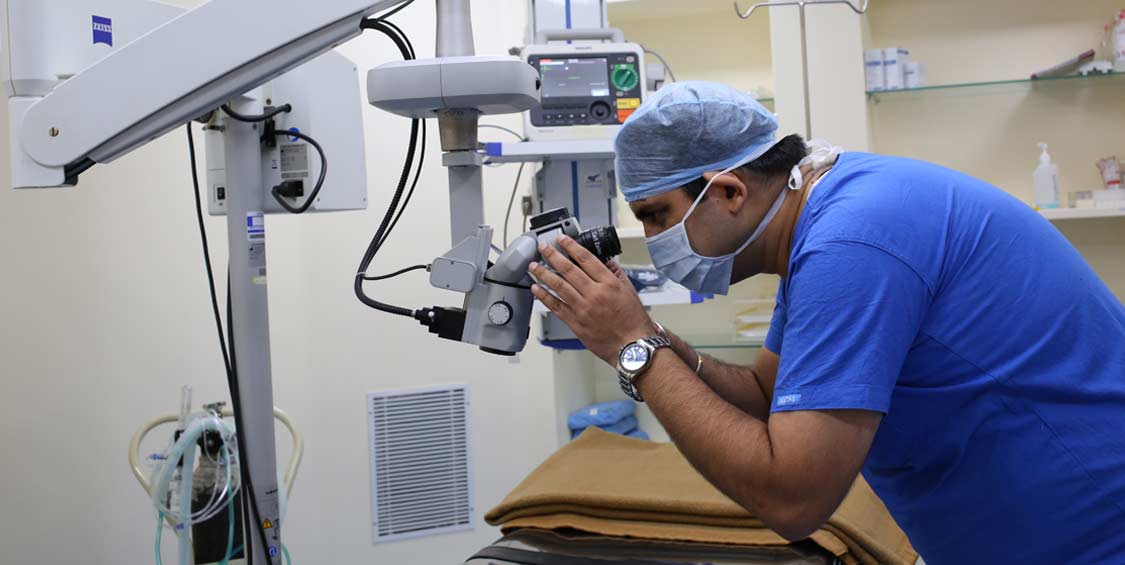
Each patient goes through a comprehensive series of eye tests and
examinations (including Corneal Topography, Pachymetry and Wavefront
analysis) before consulting with the surgeon to discuss and plan
the specifics of personal vision correction. To ensure a painless
experience the eye is anaesthetized with drops (No injections are
necessary). For the surgery, the patient lies under the laser machine
and concentrates on a flashing light for a few seconds. The patients
are in the surgery suite for about 15-20 minutes and can walk away
after the surgery. No hospitalization is required. In LASIK, both
the eyes are generally operated at the same time; no patch is applied
post-operatively. However, if you so desire, you may undergo the
procedure one eye at a time.
|
|
| |
|
|
| |
What happens after
LASIK? |
|
| |
The vision may be blurry for the first few hours after surgery
but it gradually improves. Few patients may have a mild discomfort
in the first two hours after the procedure. However, this is easily
relieved by pain-killing medication. Patients are encouraged to
rest for a day after the surgery. The precautions, which need to
be taken post-operatively, are to avoid rubbing and squeezing the
eyes. Avoid splashing water to the face or directly into the eyes.
Instillation of eye drops would start immediately after the surgery
and will continue for approximately two weeks. Most patients have
functional vision and can resume normal activities and work within
a few days. In LASIK, good vision is attained in 2-3 days. You will
have follow up examinations on the day after the surgery, after
the first week, one month, 2 months, 3 months and 6 months later.
|
|
| |
Go back
to the top » |
|
| |
Risks and side effects
of LASIK |
|
| |
As with any surgical procedure, LASIK surgery has some possible
risks and side effects that must be taken into account. A specific
end result cannot be guaranteed, although it can be closely predicted
based on data from thousands of previous cases. Side effects are
usually minimal following LASIK surgery. During the first few days
after surgery, most people can expect to experience at least some
of these effects: Increased sensitivity to light or glare. Gritty
and burning sensation in the eyes. Slightly drier eyes. Decreased
visual clarity in dim light.
In most cases, these effects decrease and eventually disappear as
the eye heals. Occasionally, some may persist.
Serious complications are fortunately very rare. Some of these
include infection, wrinkles in the flap, epithelial in growth and
increased or decreased response to correction. These complications
are treatable with medication or further surgery.
|
|
| |
|
|
| |
Epi-LASIK Eye Surgery |
|
| |
Epi-LASIK is a relatively new procedure that is technically a variation
of LASIK, and is also called epithelial LASIK or E-LASIK. Epi-LASIK
is used mostly for people in the higher refractive range where corneas
are too thin or too flat for LASIK. In this procedure, a very thin
flap is made consisting of the most superficial layer of the cornea
(the epithelium). This is followed by the excimer laser treatment
to correct your refractive error as in LASIK. At the end of the
procudere the epithelial flap is put back and a transparent protective
shield (bandage contact lens) is placed over the cornea. The epithelium
takes a few days to heal following which the bandage lenses are
removed. In the epi-LASIK procedure although the visual outcome
is the same as that of LASIK, recovery of good vision takes 8-10
days. Your surgeon will be your best judge to decide which procedure
you should undergo.
|
|
| |
Go back
to the top » |
|
| |
QUESTIONS & ANSWERS |
|
| |
1. Are both eyes treated at the same time?
Literature has shown that LASIK is an extremely safe procedure and
sight-threatening complications are rare. Patients normally prefer
to have both eyes treated at one sitting and get back to work faster.
This practice is followed worldwide. However if the patient feels
more comfortable getting only one eye treated at each session, this
can be done without any additional cost to the patient.
2. Will my number get fully corrected at the time of LASIK?
The laser is set so as to reshape your cornea to eliminate your
number completely. However during the healing process the eyes of
each person may heal slightly differently. Thus it is possible that
you may have a small residual number. Usually this does not make
it necessary for you to wear glasses for routine work.
3. Are the results of the LASIK procedure permanent?
The correction of vision done by LASIK is permanent. However LASIK
has no effect on the natural progression of your number. This is
why we only perform LASIK in patients whose number has been stable
for at least one year.
4. If required, can LASIK be performed again?
If the objectives of visual correction are not met with in the first
surgery, a second, or enhancement procedure can usually be performed
to provide additional correction. Most people do not require additional
surgery, but the higher the amount of correction necessary, the
greater is the possibility of needing an enhancement procedure.
The surgeon and the patient together assess this need and make the
decision about further surgery.
5. Will I require reading glasses?
After LASIK surgery you will be able to see all distant objects
clearly. Since LASIK cannot arrest the normal aging process of the
body, you may require glasses for reading at around 40-45 years.
Sometimes it may be possible to correct one eye for distance and
the other eye for near vision if you so desire. This is called monovision.
|
|
| |
|
|
| |
For further information consult The Cornea & Refractive
Surgery Service at Shroff Eye Centre |
|
| |
|
|
| |
Go back
to the top » |
|