



| |
|
|
| |
DIABETIC RETINOPATHY |
|
| |
|
|
| |
DIABETES MELLITUS is a condition that impairs the body's ability
to use and store sugar (glucose). Sugar is excreted in the urine
and the blood sugar is abnormally high. It causes changes in small
blood vessels in various organs of the body. Diabetes can cause
various changes in the eye as well, particularly in the retina.
Diabetic eye disease can cause severe vision loss or even blindness.
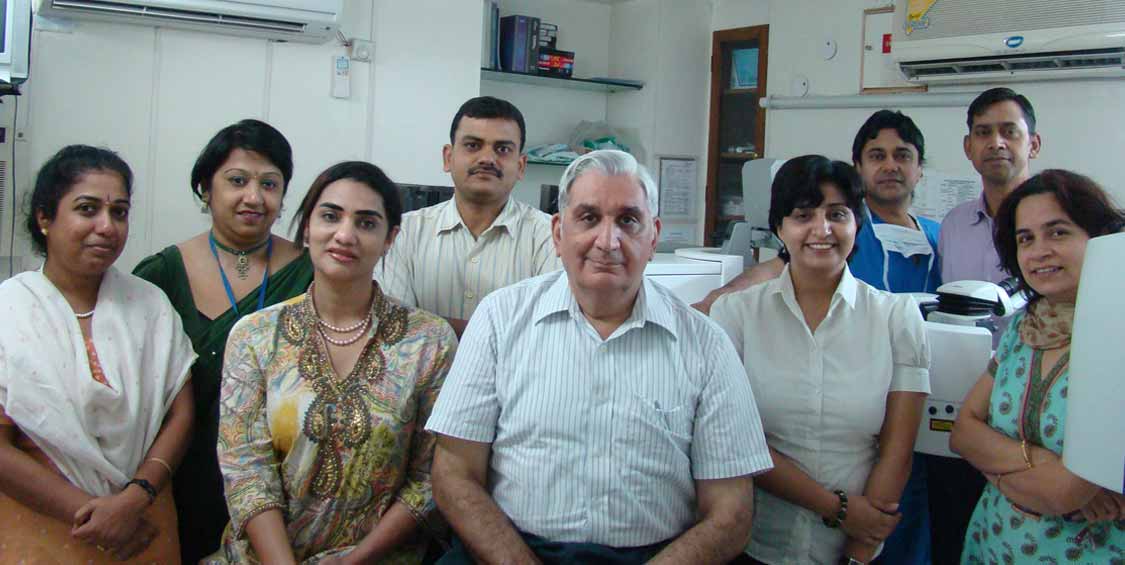
At Shroff Eye Centre, we have a dedicated team of Vitreo-Retinal
specialists committed to provide you with the best possible care
to protect your vision.
|
|
| |
|
|
| |
Learn about DIABETIC RETINOPATHY |
|
| |
How the Eye Works |
|
| |
The Retina |
|
| |
What is Diabetic retinopathy? |
|
| |
What are the Symptoms? |
|
| |
Investigations for Diabetic
Retinopathy |
|
| |
Treatment of Diabetic
Retinopathy |
|
| |
Prevention of Diabetic
Retinopathy |
|
| |
|
|
| |
How the Eye Works
|
|
| |
The
eye is like a camera in which lenses focus the picture on a light
sensitive film. In the human eye the transparent cornea and lens
focus images on the retina, a thin light sensitive film which receives
light and changes it into electrical signals which are then transmitted
to the brain by the optic nerve. Just in front of lens lies the
iris ('colored portion of the eye') with a central opening - the
pupil. This is just like the shutter or diaphragm aperture of the
camera and helps regulate the amount of light entering the eye.
The sclera ('white of the eye') is the protective outer coat of
the eye. Between the sclera and the retina lies the choroid, which
has a chiefly nutritive function. The space between the lens and
the retina is filled with a clear jelly called the vitreous body.
|
|
| |
|
|
| |
The Retina |
|
| |
The
retina can be divided into two regions: the central (macula) and the
peripheral. The macula is a very small area in the centre of the retina
upon which light rays are focused by the cornea and the lens of the
eye. The macula being the most sensitive portion of the retina is
responsible for acute (sharp) vision, - that is for reading, writing,
threading a needle and other fine tasks. The periphery of the retina
gives us vision to the side, which is called "peripheral vision".
This is what we refer to when we say, "I saw something from the corner
of my eye." |
|
| |
Go back
to the top » |
|
| |
What is Diabetic
retinopathy? |
|
| |
When the retina is affected by diabetes, weakened blood vessels
may leak fluid or blood, causing damage to the retina. This is called
DIABETIC RETINOPATHY.
There are two forms of diabetic retinopathy. In BACKGROUND RETINOPATHY,
blood vessels within the retina become abnormally permeable and
allow substances like fluid and lipid to leak out. This results
in water logging or edema of retinal tissue and deposition of yellowish
material called exudates. If the leaking fluid collects in the macula
(the central part of the retina responsible for reading vision and
other fine tasks), vision gets affected, often to a marked degree.
The second form is PROLIFERATIVE RETINOPATHY. Abnormal fragile
'new' blood vessels grow on the surface of the retina or optic nerve
and sometimes into the vitreous cavity. These fragile vessels may
rupture and bleed into the normally clear vitreous gel, blocking
light from reaching the retina. Subsequent scar formation in the
vitreous may pull on the retina, detaching it from the back of the
eye (traction retinal detachment). Severe loss of sight, blindness,
and even painful glaucoma can result from these conditions.
|
|
| |
|
|
| |
What are the Symptoms? |
|
| |
Please
note that every person with diabetes need not have Diabetic Retinopathy.
Conversely an eye with marked changes of Diabetic Retinopathy can
have good vision and be totally free of symptoms. Hence it is important
for all diabetics to undergo REGULAR EYE CHECK-UP INCLUDING RETINAL
EXAMINATION THROUGH DILATED PUPILS especially for people who have
been diabetic for a number of years. It is also true that diabetes
is often detected in a person, when some changes of retinopathy
are seen on routine examination of the eye.
Reduced central vision can occur if the macula gets edematous (swollen).
Black spots (floaters) and cobwebs of sudden onset often point to
a minor bleed inside the eye. Sudden total loss of vision may occur
due to a large bleed into the vitreous.
|
|
| |
|
|
| |
Investigations for
Diabetic Retinopathy |
|
| |
If
diabetic retinopathy is noted, color photographs of the retina may
be taken and FLUORESCEIN ANGIOGRAPHY performed. This involves dilating
the pupils and injection of a fluorescent dye into a vein in the
arm. Photographs of the retina are taken rapidly as the dye passes
through the retinal blood vessels. This test helps in determining
if laser photocoagulation treatment is necessary. If treatment is
to be done, it helps in identifying what structures and areas need
treatment with laser.
OPTICAL COHERENCE TOMOGRAPHY (OCT), which is newer non-invasive
diagnostic modality provides a cross-sectional view of the retina
and helps in quantifying the amount and type of swelling and guides
the treatment.
|
|
| |
Go back
to the top » |
|
| |
Treatment of Diabetic
Retinopathy |
|
| |
PHOTOCOAGULATION
involves the use of a LASER beam to seal leaking blood vessels and
prevent growth of abnormal blood vessels. This procedure does not
require hospitalization. In background retinopathy, if blood vessels
are leaking fluid into the macula, laser treatment stops the leakage
and may improve or stabilize vision. In proliferative retinopathy,
laser treatment may involve one or more sessions depending on the
type and severity of retinopathy. Laser treatment significantly
reduces the chances of severe visual loss by destroying the abnormal
blood vessels and preventing growth of more such vessels. Vision
may improve or stabilize within several weeks to a year. It is important
to remember that laser treatment is not a one-time procedure. Regular
follow up is extremely important. Your doctor will tell you when
to return for a check-up.
Recently, along with laser treatment, certain medication when injected
into the eye or just outside the eye has shown encouraging results.
These medicines are however to be used cautiously and judiciously.
If the vitreous is too clouded with blood or there is traction
retinal detachment, laser treatment will not work. In this situation,
a surgical procedure called VITRECTOMY needs to be performed. In
this operation, opaque vitreous gel is removed from within the eye
by a special instrument that simultaneously sucks and cuts the vitreous.
|
|
| |
|
|
| |
Prevention of Diabetic
Retinopathy |
|
| |
LOSS OF VISION FROM DIABETIC RETINOPATHY IS LARGELY PREVENTABLE.
EARLY DETECTION of diabetic retinopathy is the best protection
against sight loss. This is possible by having a complete eye examination
including retina check-up once a year or more frequently if advised.
In most cases the ophthalmologist can then begin treatment before
sight is affected.
Excellent control of diabetes and associated conditions like hypertension,
increased blood lipids & cholesterol and renal (kidney) disease,
is strongly recommended. However, good control in itself does not
guarantee freedom from diabetic retinopathy.
|
|
| |
|
|
| |
For further information consult The Vitreo-Retinal
Service at Shroff Eye Centre |
|
| |
|
|
| |
Go back
to the top » |
|