



| |
|
|
| |
The Cataract & IOL Service at Shroff
Eye Centre |
|
| |
|
|
| |
Microincision Sutureless Cataract Surgery - Modern
Microsurgery To Restore And Enhance Vision |
|
| |
Sight is our most precious sense enabling us to enjoy the beauty
of the world in which we live. Blindness has been recognized as
an important public health problem in India, a country that is now
home to a billion inhabitants. A nationwide survey, undertaken in
1999-2001, revealed the prevalence of blindness to be 8.5%. Over
60% of blindness has been attributed to cataract alone.
For centuries, developing cataract doomed a person to blindness.
Today modern microsurgical techniques utilizing state-of-the-art
equipment, lenses and surgical material, allow people to enjoy good,
clear vision after their cataracts have been removed. We at Shroff
Eye Centre believe that giving up favorite activities and suffering
through years of poor vision due to cataract is no longer an inevitable
part of the ageing process. Our centre and its team of cataract
surgeons are dedicated to provide the best possible care to patients
suffering from cataract.
|
|
| |
|
|
| |
Learn about cataract and its treatment. |
|
| |
How the eye works |
|
| |
What is a cataract? |
|
| |
Why does a cataract develop? |
|
| |
What are the symptoms of a developing cataract? |
|
| |
Can cataract be prevented or treated with
medication? |
|
| |
When can one undergo Cataract Surgery? |
|
| |
What does cataract surgery entail? |
|
| |
Are there any problems with an Intraocular
Lens (IOL)? |
|
| |
Does one need glasses after IOL surgery? |
|
| |
What are the latest advances in Intraocular
Lens (IOL) technology? |
|
| |
Can all patients having a cataract undergo
Phaco surgery? |
|
| |
Is clear vision guaranteed after surgery? |
|
| |
What are the possible complications that
can occur with Cataract & IOL surgery? |
|
| |
Can Cataract be treated with Lasers? |
|
| |
Benefits of cataract surgery |
|
| |
|
|
| |
How the eye works
|
|
| |
Before understanding cataract, it is important to know how a normal
eye works. The eye is like a camera. The lens in a camera allows
light to pass through and focuses that light on the film at the
back of the camera for a clear picture.
The eye works in a similar way. The lens of the eye is normally
clear and allows light to pass through. The light is focused on
a thin film-like retina, which is situated at the back part of the
eye. This is how we see.
|
|
| |
|
|
| |
What is a cataract?
|
|
| |
It is a cloudiness of the normally clear lens in the
eye. It prevents the lens from focusing light onto the retina and
hence causes unclear vision. As the cataract advances, this cloudiness
of vision increases over a period of time until the vision is completely
impaired. |
|
| |
Go back
to the top » |
|
| |
Why does a cataract
develop? |
|
| |
Cataract development is part of the normal ageing process.
Almost all people above the age of 60 years have cataract of a variable
degree, although it can occur at an earlier age also. In some people
cataract development is aggravated by an eye injury, presence of diabetes,
use of medications or other eye diseases. Rarely cataract may be present
in the newborn as a developmental defect. |
|
| |
|
|
| |
What are the symptoms
of a developing cataract? |
|
| |
Because cataracts form in different ways, the symptoms
of cataracts are variable. Most people notice that their vision gradually
deteriorates - objects may begin to look yellow, hazy, blurred or
distorted. Many people also find that they need more light to see
clearly, or that they experience glare or haloes from lights at night.
A common problem encountered is increasing nearsightedness. In advanced
cases, the cataract may be visible as a whitish-looking pupil.
|
|
| |
|
|
| |
Can cataract be prevented
or treated with medication? |
|
| |
Cataracts that occur due to the ageing process cannot be prevented
as the ageing process itself cannot be prevented. Using the eyes
for reading and similar activities has nothing to do with cataract
formation. Avoiding the use of eyes will not prevent cataract.
Till date as per all authentic medical research no medication exists
to prevent or cure a cataract. The only known treatment for cataract
is surgery.
|
|
| |
Go back to the top »
|
|
| |
When can one undergo
Cataract Surgery? |
|
| |
Cataract surgery can be performed as soon as the patient
feels handicapped in performing routine activities at work and leisure.
With modern microsurgical techniques of stitch-less cataract surgery
(phacoemulsification) it is not necessary to wait for the cataract
to mature. |
|
| |
|
|
| |
What does cataract
surgery entail? |
|
| |
It is one of the oldest, safest and most successful forms of surgery.
It requires a very short hospital stay and is generally performed
under local or topical anesthesia. The patient is awake during surgery
but does not feel any discomfort or pain. Patients are ambulatory
immediately after surgery and are discharged on the same day. 
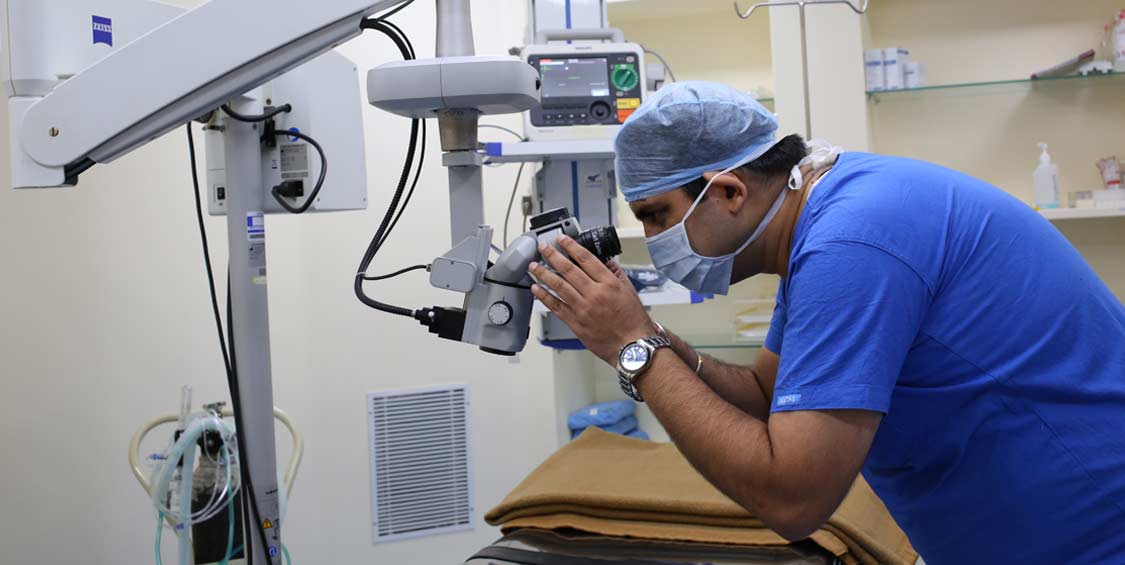
The eye operation is performed with the help of a sophisticated
operating microscope. A small incision of 2.0-2.5 mm is first made
in the eyeball (Step 1).
A smooth round opening is then made in the front part of the lens
capsule, which is a thin membrane enclosing the entire lens (Step
2).
All cloudy lens material within the lens capsule is then removed
through the same incision by the procedure of phacoemulsification
using a thin titanium probe that emits high-speed ultrasound waves,
vibrating at 40,000 times per second. This breaks the cataract into
tiny pieces, which are then suctioned out of the eye through the
same probe (Step 3).
In the final step, a Foldable Intraocular Lens (IOL) is introduced
through the small incision, and placed within the capsule of the
lens where it unfolds and stays in place securely (Step 4).
One of the most recent advancements has been the ability to perform
cataract surgery through even smaller incisions (as small as 1.8
mm). Small and micro incisions such as those used in phacoemulsification
seal themselves immediately after surgery and heal very quickly.
Compared to non-phaco cataract surgery, the postoperative rehabilitation
for stitch-less phacoemulsification is faster and one can return
to normal work and activities within a few days. This is currently
the most effective method for removing cataracts.
Great strides have been made in phacoemulsification technology.
All top-of-of-the-line phacoemulsification machines currently available
have the capability to deliver "Cold Phaco" which has the advantage
of significantly reducing the ultrasonic energy to break up the
cataract resulting in safer surgery and less damage to the eye.
A further development in this field has been the introduction of
"Torsional Phaco" (OZil Technology) available in the latest state-of-the-art
Alcon Infiniti Vision System. This revolutionary technology leads
to even further reduction of ultrasonic energy delivered in the
eye, resulting in crystal clear corneas after surgery and faster
visual recovery even in hard cataracts.
The WhiteStar Signature with Ellips "Transversal Phaco" is another
such phacoemulsification device, which has made cataract removal
a safe procedure. Both these technologies are available at Shroff
Eye Centre for the benefit of cataract patients.
|
|
| |
Go back to the top »
|
|
| |
Are there any problems
with an Intraocular Lens (IOL)? |
|
| |
Fortunately, the technological advances in IOL manufacture
and surgery have made it quite safe. Complications are rare and similar
ones can occur with conventional surgery without an IOL implantation.
All patients irrespective of other general illnesses like diabetes,
hypertension etc. can have IOL surgery. If there is any reason why
you should not have an IOL your ophthalmologist will explain. |
|
| |
|
|
| |
Does one need glasses
after IOL surgery? |
|
| |
The improvement in quality of life after cataract surgery is extraordinary,
and most patients are not dependent on their distance glasses for
daily activities. Some patients however, may need glasses of small
plus or minus power to obtain the best possible distance vision.
IOL
power calculations are done by trained personnel using a computerized
ultrasound biometer for measuring the eye before the operation,
and every endeavor is made so as to get very minimal post-operative
power in the distance glasses. A new device called the IOLMaster
is now available which is capable of very accurate measurement of
the eye and calculation of the IOL power. However, since these calculations
are based on certain theoretical formulae, it will vary on a person-to-person
basis, and some people may have a slightly larger postoperative
refraction than others. Unlike the natural human lens, which can
change its shape to focus for various distances, the IOL, since
it is made of plastic, cannot do so. Hence, majority of patients
undergoing routine phacoemulsification with IOL implantation, typically
require reading glasses after cataract surgery.
|
|
| |
Go back to the top »
|
|
| |
What are the latest
advances in Intraocular Lens (IOL) technology? |
|
| |
Advances in IOL technology have made available various state-of-the-art
IOLs. These new lens designs include 1) Blue-light blocking IOLs
that filter out harmful ultraviolet radiation as well as blue light,
2) Aberration-free IOLs which greatly improves image quality by
enhancing contrast, eliminating glare and haloes, and improving
night vision, and 3) the newer Multifocal IOLs which provides good
unaided distance and near vision with less dependence on glasses.
4) Toric IOLs are also available for the correction of high cylindrical
spectacle numbers. Depending on the patients' personal visual needs,
the surgeon decides the most appropriate lens to implant in the
eye.

|
|
| |
Go back to the top »
|
|
| |
Can all patients
having a cataract undergo Phaco surgery? |
|
| |
Your eye surgeon will be the best judge to decide whether you can
undergo phaco-surgery.
Each
patient undergoing cataract surgery is examined in detail to assess
the endothelial count of the cornea using the Automated Specular
Microscope. The endothelium is the inner most layer of the cornea
which is responsible for its transparency. Preoperative assessment
of the endothelial count enables the surgeon to identify patients
in whom this layer is weaker (low cell counts), who are not fit
for the phacoemulsification procedure, and in whom surgery by the
conventional technique would be safer. Again based on findings of
the endothelial count by specular microscopy it may be necessary
to alter certain medication used at the time of surgery. If necessary,
special protective substances such as Chondroitin Sulphate, are
used to minimize loss of the already depleted endothelial cell counts
during surgery.
|
|
| |
|
|
| |
Is clear vision
guaranteed after surgery? |
|
| |
No surgeon in the world can perform a surgery with guaranteed results.
However, almost all the patients regain good vision following cataract
surgery.
The calibre of vision obtained after a successful cataract surgery
with IOL depends upon the health of the retina behind. Eye disease
or problems in the cornea, retina or optic nerve may limit the potential
for clear vision even when the cataract surgery itself has been
successful.
However, it might not be possible to evaluate the condition of
the retina, optic nerve, in advanced cataracts.
Cataract and IOL surgery is not a magical procedure and need not
necessarily restore normal vision immediately. Blurred vision may
be present immediately after surgery. As the eye heals over a period
of time, vision improves gradually.
|
|
| |
Go back to the top »
|
|
| |
What are the possible
complications that can occur with Cataract & IOL surgery? |
|
| |
Modern microsurgical techniques for cataract removal are highly
successful procedures. The few complications that exist are becoming
even more remote, with newer developments in surgical techniques
and anesthesia.
Some minor complications that can occur include a slight drooping
of the eyelid, swelling around the eye, corneal haze, reflections
or slight distortion from the lens implant, which are usually temporary.
The chances for serious complications are negligible. Possible serious
complications include infection, severe inflammation, and hemorrhage.
In a majority of cases these complications can be treated successfully
or may resolve on their own with a good final restoration of vision.
The above list is however not exhaustive.
|
|
| |
|
|
| |
Can Cataract be
treated with Lasers? |
|
| |
Contrary
to a popular myth cataract cannot be removed with lasers. Surgery
done by phacoemulsification is commonly termed "Laser Surgery" by
many people.
However, in a certain number of patients undergoing cataract surgery,
the back part of the lens capsule may thickens over a period of
time causing blurred vision.
This is known as a secondary cataract. This is not a complication.
The condition is treated with a "YAG Laser Capsulotomy" with full
restoration of vision.
|
|
| |
Go back to the top »
|
|
| |
Benefits of cataract
surgery: |
|
| |
There are numerous benefits of cataract surgery, many
of which cannot be measured statistically. These include: -
Improved colour vision - colours are brighter and more vivid
after cataract surgery.
Greater clarity of vision - vision is crisper and sharper after
cataract surgery.
Improved quality of life - studies have repeatedly shown that
people enjoy an improved quality of life after successful cataract
surgery. Many people can resume driving, reading, writing, watching
television, sewing, household work and using a computer immediately
after.
Even when retinal diseases or other problems prevent a total restoration
of vision, the remaining vision is usually improved by cataract surgery.
|
|
| |
|
|
| |
For further information consult the Cataract & IOL
Service at Shroff Eye Centre at Shroff Eye Centre |
|
| |
|
|
| |
Go back to the top »
|
|